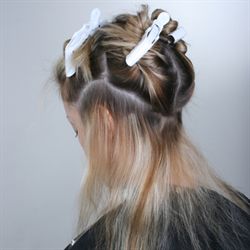
Clip-in extensions are perfect if you want
to turn your hair into beautiful flowing locks instantly. But, of course, on
the down side, they have to be removed at the end of the day. So clip-ins are
good for a party, a special date or just whenever you want to look different
for a few hours. They are much cheaper than salon-made permanent hair
extensions. Another advantage is that clip-ins don't damage your own hair in
any way.
Quality hair extensions are several strands
of hair, each attached individually. Usually 3- or 4-inch wide pieces go on the
back of your head in several layers, and a few 1- or 2-inch wide pieces are put
on the sides. As the name suggests, each strand is attaché to your own hair
with a clip. With a little bit of practice, clipping the extensions in becomes
rather easy and takes only a few minutes. Taking them off is even easier.
You can usually find 14”, 16” and 18”
clip-in extensions. Anything longer puts too much tension on your own hair.
Who can wear clip-in extensions?
Clip-in extensions are suitable for people
whose natural hair is shoulder length or longer. If you have medium length
hair, extensions can make it longer. If you have long but very fine hair, or
your hair is not in its best condition, clip-in hair extensions are a great way
to bring richness and fullness to your hair.
However, clip-in extensions will not work
for women with very short hair. Extensions only look natural when they are
mixed in with your natural hair, so if your hair is short, people will notice
that you are wearing extensions. If you have a short haircut, but are dying for
long locks, buy a wig that is similar in color to your natural hair. High
quality designers wigs look very natural - nobody will guess that you are
wearing a wig unless you tell them. If a wig is not for you, then you can go
for salon-made hair extensions that are braided or glued to your own hair.
These stay in for several months, but cost significantly more than clip-ins.
Do clip-in extensions look natural?
It depends on the quality of extensions you
get. First, you should know that hair extensions can be made from natural human
hair or from synthetic fibers. I will be honest: synthetic hair extensions are
cheap, but you get exactly what you pay for. They just don't look right. High
quality human hair clip-in extensions, on the other hand, look like they grow
from your own head.
If you look online, you will find many
brands of clip-in extension. It is best to go for a well known maker of
hair-pieces and extensions, such as Diva in a Box, PutOnPieces or Raquel Welch.
See pictures of clip-in hair extensions (will be a link) from different brands.
Since the extensions are mixed in with your
own hair, color matching is very important. And the good news is that human
hair clip-in extensions can be colored to match your own hair color exactly.
However, I wouldn't recommend doing that at home - it is better to color your
extensions at the salon. You can also use hot iron on the human hair extensions
to curl them a little.
How much do they cost?
The cost varies greatly, depending on the
material. Synthetic hair extensions will cost you less than $100. For a real
human hair extensions, you might pay from $200 to $400. However, you can get
good discounts through online hair extensions and wigs shops
Clip-in hair extensions can be real fun.
They will help you to create a different image instantly, which is very
important for a busy modern woman.